

 0
0


 Continue with Google
 Continue with Facebook
Friday 15 May, 2026
Marshall Stanmore III Review: Iconic Sound for Your Living Room
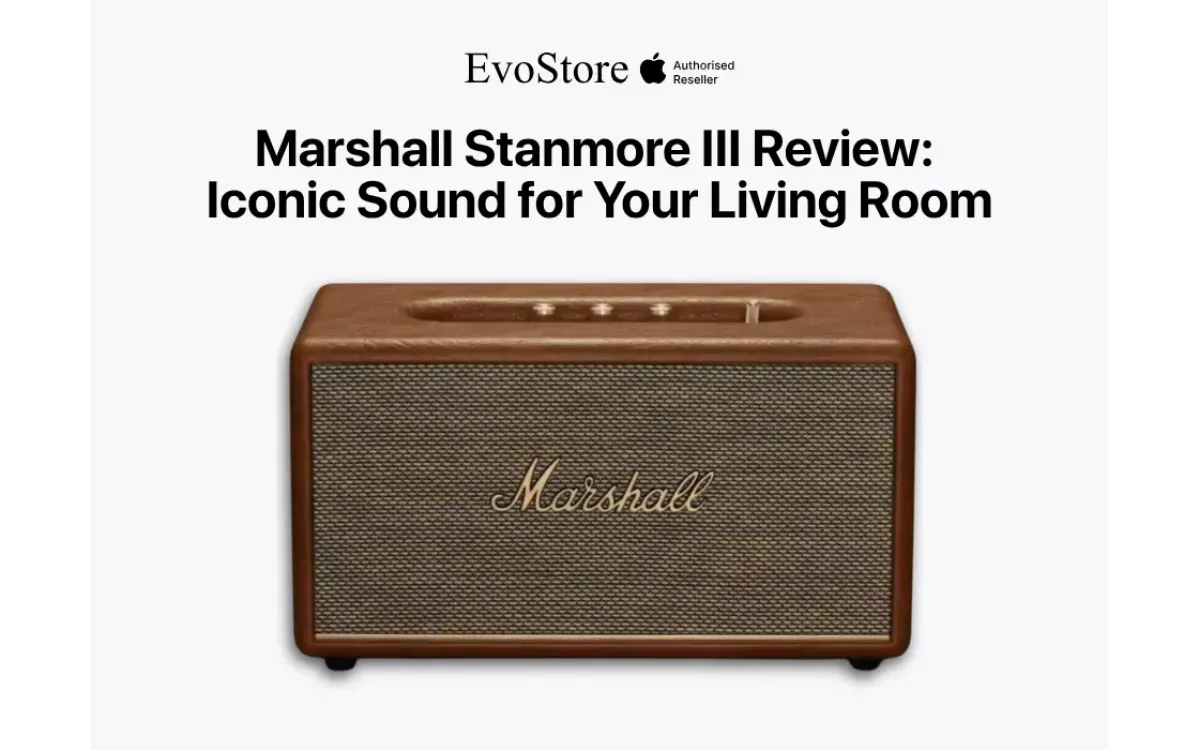
Marshall has been making amplifiers since 1962. The visual language of the brand, the black tolex covering, the gold script, the chicken-head knobs, originates in guitar amplifiers built for British rock musicians who needed more volume than anything available at the time. The Stanmore III borrows that aesthetic and applies it to a Bluetooth speaker built for living rooms rather than stages.
Quick Short Marshall Stanmore III Review:
Best for: Living room listening with premium design and strong everyday sound
Sound profile: Clear mids, controlled bass, non-fatiguing treble
Power: 80W Class D amplification with wide soundstage for a single-cabinet speaker
Connectivity: Bluetooth 5.2, RCA, and 3.5mm analog input
No battery: Mains-powered only; designed for fixed placement
Standout feature: Physical brass knobs for bass, treble, and volume adjustments
Ideal users: Buyers upgrading from budget Bluetooth speakers or soundbars
Limitations: No multi-room support, HDMI, optical input, or portability
Best placement: 20–40cm from a rear wall for fuller bass response
Price in Nepal: NPR 55,000 via Evostore Nepal with warranty support
Verdict: One of the best premium Bluetooth speakers available in Nepal if you value design, tactile controls, and balanced room-filling audio over smart features or portability.
What you are buying when you purchase a Stanmore III is partly a speaker and partly a deliberate piece of room furniture, and the degree to which that trade-off works for you depends on what you prioritise.
This review covers what the Stanmore III actually does acoustically, how it performs in practical daily use, what the controls feel like, and whether it justifies its price point for buyers in Nepal looking at premium audio options through Evostore.
1. Build and Aesthetics
The Stanmore III is a substantial object. It measures 350 x 203 x 188 millimetres and weighs 4.26 kilograms. Placed on a shelf or sideboard, it occupies the visual footprint of a small amplifier rather than a conventional Bluetooth speaker. The front grille is the same woven texture used on Marshall's guitar cabinets. The brass script logo sits centered on the grille. The top panel carries three analog control knobs for volume, treble, and bass, and the overall finish is available in black and cream variants.
The construction quality communicates solidity. The cabinet does not flex or resonate when handled. The knobs have a weighted, dampened rotation that feels calibrated rather than incidental. The rear panel carries the connectivity ports in a clean layout. Nothing about the physical object suggests cost-cutting, which matters at this price point because the aesthetic is a significant part of what you are paying for.
The Stanmore III is not portable. It runs on mains power through a captive cable and has no battery. It is designed for a fixed position in a room, which is the correct design decision for a speaker of this size and acoustic ambition. Trying to make it portable would compromise either the sound or the build quality, and Marshall has chosen to do neither.
The black version is the more versatile choice for most room configurations. The cream version reads as a more deliberate design statement and works better in lighter-toned interiors.
Summary
Large, mains-powered cabinet with guitar-cabinet grille aesthetic
Solid construction; knobs feel weighted and deliberate
Available in black or cream; no portability
2. Connectivity in Marshall Stanmore III
The Stanmore III connects via Bluetooth 5.2 (which is LE Audio ready), a 3.5 millimetre analog input, and a stereo RCA input. The inclusion of RCA is a meaningful addition for buyers in Nepal who want to connect the speaker to a turntable with a built-in preamp or a television with analog outputs. It provides a reliable physical signal path that widens the practical use case beyond pure Bluetooth streaming.
Bluetooth 5.2 provides stable connectivity at standard listening distances. Pairing is fast, and the speaker maintains a solid connection without the dropouts often found in budget hardware. The Stanmore III supports multi-point connectivity, allowing you to pair two devices simultaneously. While it doesn't always "handoff" automatically mid-song (you usually need to pause one device before the other can take over), it eliminates the need to constantly unpair and repair when switching between a phone and a laptop.
The analog inputs handle a variety of sources, from a turntable with a built-in phono preamp to a television’s auxiliary output. Signal quality through these inputs is remarkably clean. While a 3.5 millimetre connection isn't the most heavy-duty format, it works perfectly for fixed installations. For a more robust permanent connection, the RCA ports on the back are the preferred choice.
Input selection is easily managed through the source button on the top panel. The speaker remembers the last active input and returns to it on power-up, which is ideal for users who keep a consistent setup with a dedicated source like a record player.
Summary
Bluetooth 5.2 with multi-point (two devices simultaneously)
3.5mm and RCA analog inputs; useful for turntables and TVs
Remembers last active input on power-up
3. Sound Review for Marshall Stanmore III
The Stanmore III uses a two-way driver configuration powered by a total of 80 watts of Class D amplification. This is split between a single 50-watt amplifier driving the 130-millimetre woofer and two 15-watt amplifiers driving a pair of 19-millimetre tweeters. The tweeters are angled outwards to create a wider, more immersive soundstage than previous generations. The cabinet remains rear-ported, a design choice that significantly extends low-frequency response beyond what a sealed cabinet of this size could typically achieve.
The frequency response is 45 Hz to 20 kHz. The Stanmore III does not produce the sub-bass that a speaker with a dedicated woofer or a larger cabinet can achieve. What it does produce in the bass register is controlled and textured rather than bloated, which is the more useful quality for music listening across a range of genres.
The midrange is where the Stanmore III performs most consistently. Vocal reproduction is clear and positioned well in the soundstage. Acoustic instruments, piano, guitar, and strings retain definition and body at moderate listening volumes without the compression that lower-quality speakers apply to manage dynamic range. The speaker does not favour any particular genre in the way that speakers optimized for electronic music or for classical reproduce some material convincingly and others poorly.
Treble is extended without being aggressive. High-frequency detail is present and contributes to the openness of the soundstage without introducing listening fatigue at the volumes typical of living room use. The treble knob on the top panel allows meaningful adjustment rather than the marginal trimming that tone controls on lesser speakers produce.
The bass and treble controls are the most useful feature of the analog control layout. A moderate bass boost adds warmth and weight that suits jazz, soul, and acoustic material. Reducing treble slightly suits electronic and hip-hop material at higher volumes where high-frequency content can become tiring. The ability to make these adjustments without opening an app is a practical benefit that becomes apparent over time.
Stereo separation on a single-cabinet speaker is inherently limited by physics. The Stanmore III presents a wider soundstage than its cabinet dimensions suggest, but it is not a substitute for a two-speaker stereo setup in a room where spatial separation is a priority. For background listening and moderate-volume foreground listening in a single room, the soundstage is adequate. For critical listening where left-right separation and imaging matter, a stereo pair arrangement is the correct solution.
Volume at maximum is substantial for a single-cabinet speaker. The Stanmore III can fill a medium to large living room without audible distortion. It does not compress at high volumes the way underpowered speakers do. Most domestic listening happens between 30 and 70 percent of maximum volume, and across that range the speaker performs consistently.
Summary
80W Class D, two-way driver; 45Hz–20kHz response
Strong midrange; controlled bass; non-fatiguing treble
Physical tone knobs offer meaningful adjustment; stereo separation limited by single-cabinet design
4. The Marshall Bluetooth App
The Stanmore III is compatible with the Marshall Bluetooth app, which provides equalizer control beyond the three physical knobs, firmware update management, and a small set of additional settings. The app is functional rather than sophisticated. It adds an equalizer with adjustable bands and a handful of presets, and it handles firmware updates without requiring user intervention beyond initiating the process.
The physical controls are more satisfying to use than the app for routine volume and tone adjustment. The app fills the gap for users who want parametric EQ beyond treble and bass shelving, or who want to save specific EQ profiles for different listening scenarios. It is not a compelling feature in its own right but it adds flexibility for users who want it.
App dependency for core functions is absent, which is the correct design priority. A speaker that requires an app to access basic settings ages poorly as software support evolves and phone operating systems change. The Stanmore III's physical controls cover all routine operations independently of the app.
Summary
Adds parametric EQ and firmware updates
Physical controls handle all routine use without the app
App is functional but not a standout feature
5. Practical Living Room Use
The Stanmore III handles daily living room use with quiet confidence. Flip the brass toggle, connect via Bluetooth, and the speaker sounds balanced within seconds.
Placement matters more than most expect; sitting 20 to 40 centimetres from a rear wall reinforces the bass, while pulling it further into the room thins the low end but opens up the soundstage.
A few things that stand out in everyday use:
The top-mounted brass power lever feels deliberate and premium, not like an afterthought
Controls are visible and physical, not buried in an app or hidden on the back panel
Automatic standby manages power during inactivity, though the manual toggle is far more satisfying to use
Volume adjustment is simple and immediate
For a speaker that makes no attempt to be smart, the Stanmore III is remarkably easy to live with. It does not ask much of the listener beyond a good position and a Bluetooth connection, and in return it delivers consistent, room-filling sound that rarely calls attention to itself.
In a market full of speakers that demand configuration to perform, that kind of straightforward reliability feels less like a compromise and more like a considered choice.
Who It Is For
The Stanmore III suits someone who listens daily in a fixed room, values analog controls over app dependency, and wants the speaker to hold its own as a piece of the room. It works equally well for the person playing vinyl through a turntable preamp and the person streaming from a phone all day via Bluetooth. The use case is domestic, stationary, and unhurried.
It is not the right purchase for everyone:
Not suited for anyone who needs portability or multi-room capability
Does not deliver the deepest possible bass from a single cabinet
Where it does make sense:
Buyers moving up from a Bluetooth soundbar or budget desktop speaker will find it a substantive upgrade
A considered gift for someone who values design and sound quality in equal measure
Well matched to a room that already has a personality and needs a good speaker to match it
The Marshall Stanmore III retails at NPR 55,000 through Evostore at evostore.com.np, with local warranty coverage and after-sales support included.
NPR 55,000 for a single-cabinet Bluetooth speaker is a deliberate purchase. The Stanmore III earns it. The build is solid, the sound is consistent across genres and volumes, and the analog controls mean you are never reaching for a phone to do something the knobs already handle. If this is the speaker category you are shopping in, this is the one to buy.
FAQs
1. Is the Marshall Stanmore III worth the price in Nepal?
At its price point, the Stanmore III delivers acoustic performance, build quality, and aesthetic coherence that cheaper alternatives do not. The cabinet construction, driver quality, and amplifier output combine to produce a speaker that sounds consistently good across genres and listening volumes without requiring ongoing management.
2. Can the Marshall Stanmore III connect to a television?
Yes, but via analog connection. The RCA input on the rear panel allows you to connect to a television's RCA or headphone output using a standard cable. This provides a stable, lag-free signal. Unlike some other home speakers, it does not have an Optical or HDMI input, so check your TV's available outputs first
3. Does the Marshall Stanmore III support multi-room audio?
No. The Stanmore III operates as a standalone speaker and does not support multi-room audio protocols such as AirPlay 2 or Chromecast. It cannot be grouped with other speakers for synchronized playback across multiple rooms. Buyers who want multi-room capability need to look at speakers built on those platforms specifically. The Stanmore III is designed for single-room use and does not attempt to extend beyond that function.
4. How does the Stanmore III compare to the Stanmore II?
The Stanmore III updates the Stanmore II with Bluetooth 5.2 (up from 5.0), a more eco-friendly PVC-free build, and a re-engineered soundstage with outward-angled tweeters. While the Stanmore II was already excellent, the III offers better high-frequency dispersion and "future-proof" Bluetooth connectivity.
5. Where can I buy a genuine Marshall Stanmore III in Nepal?
Evostore at evostore.com.np is the verified source for genuine Marshall products in Nepal. Purchasing through Evostore provides confirmed product authenticity, local warranty coverage, and access to after-sales support in Nepal.