

 0
0


 Continue with Google
 Continue with Facebook
Wednesday 20 May, 2026
Marshall Acton III vs Stanmore III: Which Home Speaker to Buy in Nepal?
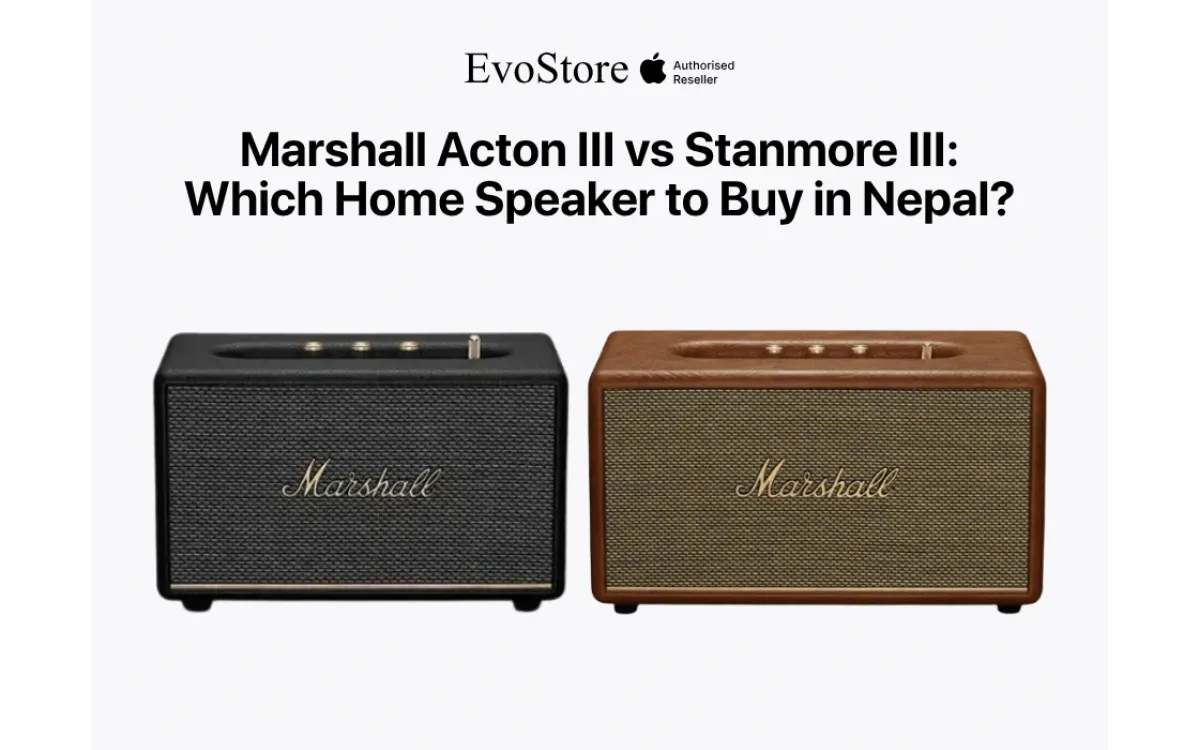
Marshall makes two Bluetooth speakers that dominate the same conversation: the Acton III and the Stanmore III. Both sit on the same shelf in the same category of home audio. Both carry the same aesthetic DNA. Both are sold through Evostore in Nepal and occupy adjacent price points. If you are deciding between them, the question is not which one is better in absolute terms. It is which one is right for your room, your listening habits, and the role you want the speaker to play.
This comparison covers the differences between the two, what those differences produce in actual listening conditions, and how to make the decision without overthinking it.
Marshall Acton III vs Stanmore III: Summary
The Stanmore III is the larger of the two. It has a bigger cabinet, more amplifier power, and handles loud listening in a large room without breaking a sweat.
The Acton III is the compact one. Looks practically identical, just takes up less space and loses the RCA input. Perfectly suited to a bedroom or study.
Size and Physical Presence
This is where the decision starts for most buyers, because the size difference between these two speakers is not trivial.
The Acton III measures 260 x 170 x 150 millimetres. The Stanmore III measures 350 x 203 x 188 millimetres. Contrary to what the names might suggest, the Stanmore III is actually the larger of the two by a meaningful margin. Placed side by side, the Stanmore III reads as a more substantial object. The Acton III, by comparison, sits comfortably on a bookshelf, a side table, or a modest entertainment unit without dominating the space around it.
If your intended placement is a large living room sideboard or a dedicated audio shelf with room to breathe, the Stanmore III fits the position well. If your placement is a smaller room, a bedroom, a study, or a shelf with adjacent objects competing for space, the Acton III is the more practical choice dimensionally before any acoustic consideration enters the picture.
Both speakers run on mains power. Neither is portable. Both share the same design language: woven grille, brass Marshall script, analog control knobs on the top panel, and the same finish options. The aesthetic difference between them is scale rather than character.
Driver Configuration and Power Output
The acoustic difference between the Acton III and the Stanmore III begins with the hardware inside the cabinet.
The Acton III runs a three-amplifier configuration:
One 30-watt Class D amplifier driving the woofer
Two 15-watt Class D amplifiers driving the tweeters
Total system power: 60 watts
The Stanmore III runs a three-amplifier configuration:
One 50-watt Class D amplifier driving the woofer
Two 15-watt Class D amplifiers driving the tweeters
Total system power: 80 watts
The Stanmore III has a higher total amplifier power than the Acton III, and its larger cabinet gives the woofer more air volume to work with. Both factors combine to produce a bass response that is more extended and more physically present than the Acton III can achieve within its smaller cabinet.
This difference is audible, and it matters in large rooms. The Stanmore III moves more air. At moderate to high listening volumes in a medium to large room, the Stanmore III maintains its composure, and its bass response stays controlled. The Acton III in the same room at the same volume begins to reach the limits of what a smaller cabinet and 60 watts can produce without compression.
In a small room at moderate volumes, this difference narrows considerably. The Acton III's bass response is entirely adequate for a bedroom or a study where listening distances are short and volume requirements are modest.
Sound Character
Both speakers share a tonal character that is Marshall's consistent house sound: warm midrange, extended but not aggressive treble, and bass that prioritises body and texture over deep sub-bass extension. Neither speaker produces significant output below 50 to 60 Hz. Neither is attempting to replicate a subwoofer. What they produce in the bass register is present and musical rather than bloated or absent.
The Stanmore III's additional woofer power and cabinet volume extend this bass response downward and increase its authority at volume. Listening to jazz, soul, or acoustic music at moderate volume, the difference between the two speakers is subtle. Both reproduce the weight of a double bass, the body of a piano, and the warmth of male vocals with the same character. Listening to electronic music, hip-hop, or any genre where bass lines need to sustain at higher volumes, the Stanmore III pulls ahead in a way that is immediately apparent.
Midrange on both speakers is where Marshall consistently performs well. Vocals sit forward and clear in the mix. Acoustic instruments retain definition and body. Neither speaker recesses the midrange to create an artificially exciting bass and treble presentation, which is a common quality compromise in speakers competing on perceived excitement rather than accuracy.
Treble on both is extended and detailed without fatigue. The treble control on both top panels provides a meaningful adjustment range rather than marginal trimming.
Soundstage from a single-cabinet speaker is inherently limited by the physical separation of the drivers. The Stanmore III's wider cabinet creates marginally more left-right separation than the Acton III, but neither speaker produces the spatial presentation of a stereo pair. For background to moderate-volume foreground listening in a single room, both are adequate. For critical listening where imaging and spatial separation are priorities, neither replaces a two-speaker stereo configuration.
Connectivity
The two speakers differ slightly in their wired connectivity options, which is worth knowing before you buy.
The Acton III offers:
Bluetooth 5.2
3.5mm analog input
The Stanmore III offers:
Bluetooth 5.2
3.5mm analog input
RCA input
The Stanmore III's RCA input is an advantage for buyers connecting a turntable with RCA outputs, which is the standard output on most record players. The Acton III does not have this, so turntable users would need either a turntable with a built-in preamp and a 3.5mm output or a separate preamp with a 3.5mm connection.
Input selection is managed through the rear panel source button on both units. Both are compatible with the Marshall Bluetooth app for EQ adjustment and firmware updates.
Neither speaker supports multi-room audio protocols. Neither supports AirPlay 2 nor Chromecast. Both operate as standalone units. This is a consistent Marshall design position across the home speaker range and is not a differentiator between the two models.
Bluetooth pairing on both is fast and stable. Neither has a multi-point simultaneous connection, meaning switching between source devices requires manual reconnection from the new device rather than automatic handoff.
Controls and App
Both speakers have an identical top panel control layout: volume, treble, and bass knobs with the same weighted, dampened feel. The Marshall Bluetooth app adds parametric EQ capability and firmware management to both speakers in the same way.
The analog controls cover all routine daily operations without requiring the app. The app adds flexibility for users who want to save specific EQ profiles for different listening scenarios, but it is not required for the speaker to function at its design specification.
Comparison Table: Marshall Acton III vs Stanmore III
| Acton III | Stanmore III | |
| Price | NPR 42,900 | NPR 65,000 |
| Dimensions | 260 x 170 x 150 mm | 350 x 203 x 188 mm |
| Weight | 2.85 kg | 4.25 kg |
| Total Power | 60 W | 80 W |
| Woofer Amp | 30 W | 50 W |
| Tweeter Amps | 2 x 15 W | 2 X 15 W |
| Bluetooth | 5.2 | 5.2 |
| 3.5mm Input | Yes | Yes |
| RCA Input | No | Yes |
| Best For | Small to medium rooms | Medium to large rooms |
Which One to Buy: Marshall Acton III or Stanmore III
Buy the Acton III if:
Your room is small to medium
You listen at moderate volumes in a bedroom, study, or secondary room
Placement space is a constraint
You want the Marshall aesthetic in a more compact form factor
You do not need an RCA input
Your room is small to medium
You listen at moderate volumes in a bedroom, study, or secondary room
Placement space is a constraint
You want the Marshall aesthetic in a more compact form factor
You do not need an RCA input
Buy the Stanmore III if:
Your room is medium to large
You listen at moderate to high volumes regularly
Bass weight and extension at volume are important to your listening experience
You have a turntable and want to connect via RCA
The speaker is the primary audio source for a living room or entertainment space
The honest summary is this: in a small room at moderate volume, the Acton III sounds excellent, and the Stanmore III's advantages are largely wasted. In a large room at moderate to high volume, the Stanmore III performs as the better speaker, and the Acton III is working harder than it should be. Buy for the room and the volume, not for the name or the price.
Both Marshall speakers are available through Evostore in Nepal with verified authenticity, local warranty coverage, and after-sales support.
Your room is medium to large
You listen at moderate to high volumes regularly
Bass weight and extension at volume are important to your listening experience
You have a turntable and want to connect via RCA
The speaker is the primary audio source for a living room or entertainment space