

 0
0


 Continue with Google
 Continue with Facebook
Tuesday 30 June, 2026
Action Camera vs. Smartphone Camera: Why You Still Need an Insta360 for Traveling in Nepal
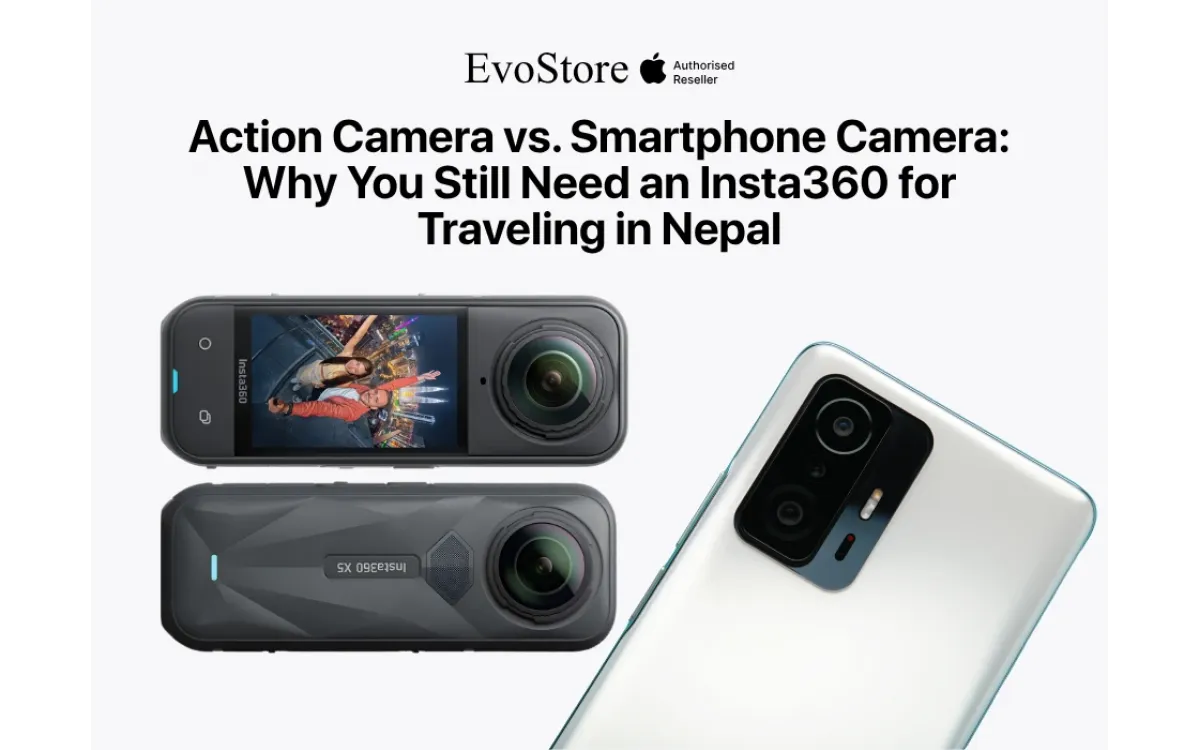
The argument for leaving the action camera at home and shooting everything on your phone gets more persuasive every year. Smartphone cameras have closed the gap significantly. Computational photography handles low light better than it used to. Stabilisation has improved. The editing workflow from phone to social media is frictionless in a way that dedicated cameras are not.
For most travel, this argument holds. For Nepal specifically, it does not.
Nepal's terrain, altitude, weather conditions, and the specific visual opportunities the country presents expose the limitations of a smartphone camera in ways that a weekend city trip never would. This is not a general case for action cameras over smartphones. It is a specific case for why a trip to Nepal changes the calculation.
Quick Summary: Action Camera vs. Smartphone Camera
A smartphone camera is ideal for city photography, food, portraits, and casual travel content in Kathmandu and Pokhara.
The Insta360 X5 excels on Nepal's trekking trails with superior stabilization, rugged durability, and immersive 360° capture.
Cold temperatures and high altitude reduce smartphone battery life more noticeably than a dedicated action camera.
The Insta360 X5's FlowState stabilization, invisible selfie stick, and AI editing create smoother, cinematic footage on uneven mountain trails.
Waterproof construction and weather resistance make the X5 more reliable in Nepal's dust, rain, and challenging trekking conditions.
Using both a smartphone and an Insta360 X5 gives travelers the best combination for city sightseeing and Himalayan adventures.
The Insta360 X5 is available at Evostore Nepal with local warranty support and genuine product assurance.
What Your Phone Does Well
Before making the case for an Insta360, it is worth being honest about where the phone wins.
Smartphones in 2026 are genuinely excellent for:
Portrait shots at heritage sites like Pashupatinath, Boudhanath, and the Durbar Squares, where you are standing still, and the lighting is reasonable
Food and market photography in Thamel and Lakeside Pokhara
Casual video of street life and cultural moments
Low-effort social media content that requires no post-processing
Night photography in well-lit urban environments where the computational photography engine has time to work
In Kathmandu and Pokhara at ground level, a flagship smartphone covers most shooting scenarios without compromise. The problem starts when you leave the city.
Where the Smartphone Fails vs Action Cameras
1. Altitude and Cold
Batteries degrade rapidly in cold conditions. On the Everest Base Camp trail, the Annapurna Circuit, or any high-altitude route in spring or autumn, overnight temperatures drop well below freezing, and daytime temperatures at altitude are far colder than the Kathmandu valley. A flagship smartphone that delivers 12 hours of battery at sea level may deliver four to five hours at 4,000 metres in October.
Action cameras are not immune to cold battery drain, but they are designed for outdoor use in variable conditions and handle the temperature range of Nepal's trekking altitudes more reliably than a device designed primarily for ambient temperature operation.
2. Stabilisation on the Move
Smartphone stabilisation is excellent for walking on flat surfaces. On a trekking trail with uneven stone, loose scree, river crossings, and the specific gait of someone carrying a daypack at altitude, it is not adequate for smooth video. The footage is watchable, not cinematic.
The Insta360 X5's FlowState 6-axis gyro stabilisation is in a different category. It was built specifically for high-motion, unpredictable movement. Point-of-view footage from a chest mount, helmet mount, or selfie stick on a Nepal trail looks fundamentally different from smartphone handheld footage of the same section.
3. Dust and Weather Resistance
Nepal's trails generate significant dust, particularly in the Kali Gandaki corridor through Mustang and on dry-season routes. River crossings, monsoon rain if you are trekking out of season, and the general outdoor exposure of a multi-day trek create conditions that a smartphone is not rated to handle continuously.
The Insta360 X5 is waterproof to 10 metres with the dive case and built for the conditions Nepal produces as standard. Shooting in rain, near waterfalls, or in dusty conditions requires no additional concern.
4. The Angles Nepal Demands
The landscapes of Nepal, Himalayan panoramas, deep river gorges, the approach to high passes, and the interior of ancient monasteries require angles that a hand-held smartphone cannot produce. A chest-mounted action camera captures the trail underfoot and the mountain behind simultaneously. The Insta360 X5's invisible selfie stick feature produces footage that looks like it was shot by a drone operator, not someone holding a stick. A time-lapse of clouds moving across Annapurna requires a fixed mount that a smartphone balanced on a rock cannot reliably deliver.
Why Use the Insta360 X5 Specifically Instead of Smartphones
1. 360-Degree Capture at 8K
The Insta360 X5 shoots full 360-degree video at 8K, which you reframe in post rather than in the moment. On a Nepal trek, where something visually significant can appear in any direction at any time, shooting 360 and deciding the frame later is a fundamentally different workflow from pointing a camera in one direction and hoping. A yak train passing on a narrow trail, a sudden Himalayan panorama through a break in cloud, a monastery interior, all of these benefit from capture first and frame later.
The 72-megapixel 360-degree photo capability produces stills at a resolution that holds up to significant cropping and reframing, which matters when the shot you wanted was slightly off center.
2. Invisible Selfie Stick
The Insta360 X5's invisible selfie stick effect removes the stick from 360-degree footage entirely, producing shots that look like a third-person camera operator followed you up the trail. For solo travellers or anyone navigating Nepal without a second person behind the camera, this is a practical capability that no smartphone can replicate. It changes what solo travel photography looks like at a fundamental level.
3. AI-Powered Editing
The Insta360 app uses AI to identify the best moments from a day's footage and assembles edits with auto-tracking, reframing, and dynamic transitions automatically. For trekkers covering eight hours of trail per day who do not want to spend their rest hours in editing software, this workflow produces shareable content from raw footage with minimal effort.
4. Voice and Gesture Control
Hands-free operation through voice commands or gestures means the camera can be mounted and triggered without stopping or reaching for a button. On a trail where both hands are on trekking poles or where the shot requires the camera to be out of arm's reach, this is an operationally useful feature rather than a novelty.
5. Durability Matched to the Environment
Waterproof to 10 metres with the dive case, rugged construction, and 8K video from an 180-gram body. The X5 handles the full range of conditions Nepal's trekking environment produces.
Get the Insta360 X5 at Evo Store Nepal
The Insta360 X5 8K Action Camera is available at Evo Store at NPR 89,500 through Evostore. The standard bundle includes the camera body, a rechargeable battery rated at approximately 80 minutes of continuous shooting, a USB-C charging cable, a protective pouch, a lens cap, and a user manual.
Optional accessories available separately include the selfie stick, dive case for waterproofing to 10 metres, bullet time cord, and mounting brackets for chest, helmet, and fixed mount applications. For a Nepal trekking trip, the selfie stick and a mounting bracket are the accessories most directly relevant to the shooting scenarios the country presents.
The battery's 80-minute continuous rating will deliver less at altitude in cold conditions. Carrying a spare battery is practical for any multi-day route where charging opportunities are limited to lodge evenings.
The Honest Recommendation: Action Camera vs. Smartphone Camera
For a Nepal trip that stays in Kathmandu and Pokhara and involves no trekking above 2,000 metres, a flagship smartphone covers most shooting scenarios, and the Insta360 X5 is a considered upgrade rather than a necessity.
For any trip that involves trekking, altitude above 3,000 metres, multi-day routes, or the specific visual ambitions that Nepal's landscapes create, the Insta360 X5 is the most capable single camera you can carry. The 360-degree capture, invisible selfie stick, AI editing workflow, and durability ratings cover the full range of what Nepal demands from a travel camera in one 180-gram device.
The smartphone handles the rest. The two together cover everything.
The Insta360 X5 is available through Evostore with a verified genuine product and local warranty coverage in Nepal.
FAQs for Action Camera vs. Smartphone Camera
1. Is an action camera worth buying specifically for a Nepal trip?
For a trip that includes trekking, high altitude, or multi-day routes, yes. Cold battery drain at altitude, the stabilisation requirements of trail footage, and the angles that Nepal's landscapes demand expose smartphone limitations that do not appear on most other trips. For a Kathmandu and Pokhara city trip with no trekking, a flagship smartphone covers most scenarios adequately.
2. What makes the Insta360 X5 suitable for Nepal trekking specifically?
The 360-degree capture with reframing in post, FlowState 6-axis stabilisation designed for high-motion movement, waterproofing to 10 metres with the dive case, and the invisible selfie stick effect for solo travellers all address the specific shooting conditions and requirements that Nepal's terrain and landscapes create. The 180-gram weight is also manageable across a multi-day trek where every gram in the daypack is felt by the end of the day.
3. How does the Insta360 X5 handle cold at high altitude in Nepal?
Better than a smartphone but with reduced battery performance relative to the rated specification. The 80-minute continuous battery rating will deliver less at altitude in cold conditions. Carry a spare battery, keep the camera inside your jacket between shots above 4,000 metres, and plan for shorter battery life than the specification suggests. Charging at lodge rooms each evening is the standard management approach on multi-day routes.
4. Can I use my smartphone alongside the Insta360 X5 rather than replacing it?
Yes, and this is the most practical approach. The smartphone handles static photography at heritage sites, portraits, and casual content. The Insta360 X5 handles trail footage, 360-degree capture, and the conditions where smartphone limitations become apparent. The two cover the full range of shooting scenarios Nepal presents without either device carrying the full load.
5. Where can I buy the Insta360 X5 in Nepal with warranty?
Evo Store at evostore.com.np carries the Insta360 X5 at NPR 89,500 with verified genuine product and local warranty coverage. Purchasing through Evo Store removes the counterfeit and grey market risk that exists in the broader South Asian camera market and ensures warranty claims are handled locally.